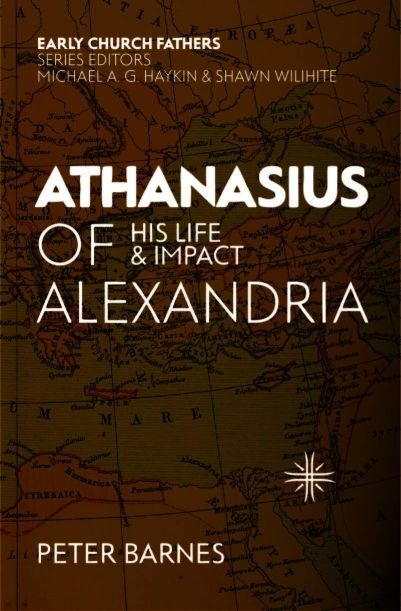
Today, I had the privilege to present the book Athanasius of Alexandria: His Life & Impact through the 194th Episode of Roots & Aerial Roots Missionary History. Please watch here. Its in Tamil. You could also read the gist of my presentation below
As we begin the Lenten Season Athanasius reminds us the need to stand firm in our Faith.
Introduction: The World on a Razor’s Edge
Imagine a world where the Church has finally emerged from the fires of Roman persecution, only to face an even greater threat from within. A popular, charismatic priest named Arius begins to preach a message that sounds logical: “There was a time when the Son was not.” He argued that Jesus was the highest of creatures, but a creature nonetheless.
In his book, Peter Barnes shows us that this wasn’t just a debate over Greek grammar. If Arius was right, the bridge between God and man was broken. If Jesus is a creature, he cannot save us. Standing in the gap was one man, often alone, often in exile, but never wavering: Athanasius of Alexandria.
The Fortress of Nicea
At the Council of Nicea in 325, Athanasius was only a young deacon, yet he was the intellectual engine behind the word that changed history: Homoousios—meaning Christ is of the “same substance” as the Father.
Barnes highlights that Athanasius’s firmness was rooted in a simple, terrifying realization: Only God can save. * A creature cannot redeem a creature.
- If the Word is not truly God, our worship is idolatry and our salvation is a myth.
Athanasius didn’t just want to win an argument; he wanted to protect the souls of the faithful. When the Council ended, most thought the battle was over. In reality, for Athanasius, it was just the beginning of a 45-year war.
The Fugitive Bishop: 17 Years of Exile
Peter Barnes details the five times Athanasius was driven from his home. He was hunted by Roman emperors who wanted a “political peace” at the expense of theological truth.
The Price of Firmness:
- At the Council of Tyre, his enemies framed him for murder and rape. He didn’t flinch. He produced the “dead man” alive and well, exposing their lies with a touch of wit.
- During his Third Exile, when 5,000 soldiers stormed his church at night, he sat calmly on his throne and led his people in a Psalm of praise before vanishing into the desert.
- He lived in caves, in tombs, and with monks. Why? Because he refused to sign “vague” creeds. To Athanasius, a “gray area” in the Gospel was a black hole for the truth.
When the world turned Arian, and the Emperors demanded compromise, Athanasius stood his ground. This is where we get the phrase Athanasius Contra Mundum—Athanasius against the world. He was the “Black Dwarf” who stood taller than the Emperors.
The Fullness of the Trinity: The Holy Spirit
As Athanasius grew older, a new heresy emerged that attacked the deity of the Holy Spirit. People argued that maybe the Son was God, but the Spirit was just a servant.
Athanasius stood firm again. In his Letters to Serapion, he argued that the Trinity is an indivisible unity. If you deny the deity of the Spirit, you are left with a “dyad” or a fragmented God. He insisted that the Spirit who sanctifies us must be as Divine as the Son who saves us.
Conclusion: The Legacy of the Creed
Athanasius died in 373, just a few years before the final victory at the Council of Constantinople. He never saw the full triumph of his cause with his own eyes, but he felt it in his soul.
Key Aspects of Athanasius’s Life:
- Doctrinal Integrity: He believed truth was worth more than his life or his comfort.
- Pastoral Heart: His theology wasn’t for the classroom; it was for the person in the pew who needed a Savior who was truly God.
- Christ-Centered Focus: From his book On the Incarnation to his final breath, everything was about the glory of Jesus Christ.
The Significance of the Nicene Creed:
Today, we recite the Nicene Creed not as a boring list of rules, but as a victory song. Because Athanasius stood firm, we can say with confidence:
“We believe in one Lord Jesus Christ… God from God, Light from Light, true God from true God… being of one substance with the Father.”
If Athanasius had compromised, Christianity might have become just another Roman philosophy. Because he stood “Contra Mundum,” the light of the true Gospel still shines today.
Closing Statement: May we have even a fraction of his steel. May we stand firm for the Truth, no matter who stands against us.